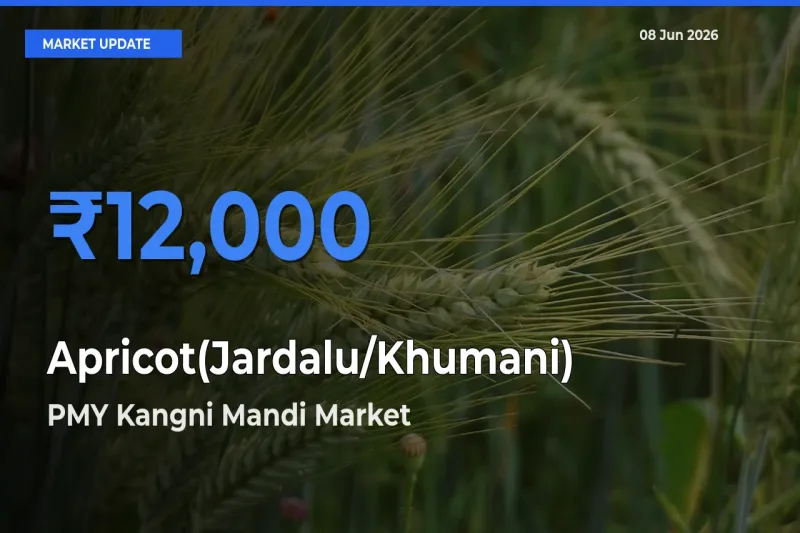
In today’s mandi price update dated 08 Jun 2026, PMY Kangni Mandi secured the top mandi position for Apricot(Jardalu/Khumani) by recording the highest traded rate of ₹12,000 per quintal. Among all active agricultural markets, this mandi delivered the strongest price performance, making it the benchmark for today’s commodity trading session.
When one mandi leads the price chart across multiple regions, it reflects competitive bidding strength, quality arrivals, and concentrated buying demand. Such leadership is closely monitored by farmers, traders, and procurement agencies tracking daily mandi rates for strategic decisions.
Why PMY Kangni Mandi Became the Top Mandi Today
- Highest Recorded Price: ₹12,000
- Average Price: ₹10,900
- Total Reporting Mandis: 3
- Date: 08 Jun 2026
- Commodity: Apricot(Jardalu/Khumani)
A top mandi position is rarely the result of a single trade. It typically reflects broader market competitiveness, where multiple buyers actively compete for available stock. Strong average prices further confirm that leadership is supported by consistent transaction activity.
Top Mandis Comparison – Regional Price Benchmark
| Mandi | Price (₹ per quintal) |
|---|---|
| PMY Kangni Mandi | ₹12,000 |
| SMY Jaisinghpur | ₹11,700 |
| Patiala APMC | ₹9,000 |
The comparison table clearly shows how PMY Kangni Mandi outperformed other major mandis. In many cases, the leading mandi becomes the reference point for price negotiations in surrounding markets.
30-Day Performance Context – Sustained Strength?
Over the last 30 days, Apricot(Jardalu/Khumani) prices ranged between ₹1,500 and ₹23,000, with the average hovering near ₹8,482.
If today’s top rate approaches or exceeds the monthly high, it signals strong structural demand. Consistent performance near upper price bands enhances the mandi’s credibility as a leading agricultural hub.
20-Day Historical Price Trend
| Date | High (₹) | Low (₹) | Average (₹) |
|---|---|---|---|
| 08 Jun | ₹15,000 | ₹7,000 | ₹10,900 |
| 06 Jun | ₹12,000 | ₹5,000 | ₹9,100 |
| 05 Jun | ₹16,500 | ₹3,500 | ₹9,514 |
| 04 Jun | ₹20,000 | ₹5,000 | ₹10,230 |
| 03 Jun | ₹23,000 | ₹5,000 | ₹10,757 |
| 02 Jun | ₹18,000 | ₹4,500 | ₹10,380 |
| 01 Jun | ₹15,000 | ₹2,000 | ₹9,563 |
| 31 May | ₹13,000 | ₹2,500 | ₹7,650 |
| 30 May | ₹12,000 | ₹5,000 | ₹8,071 |
| 29 May | ₹12,500 | ₹2,500 | ₹7,250 |
| 28 May | ₹12,000 | ₹7,000 | ₹9,125 |
| 27 May | ₹13,000 | ₹1,500 | ₹7,641 |
| 26 May | ₹11,500 | ₹2,500 | ₹7,000 |
| 25 May | ₹12,000 | ₹2,000 | ₹7,722 |
| 24 May | ₹8,000 | ₹2,500 | ₹6,000 |
| 23 May | ₹11,000 | ₹3,500 | ₹8,188 |
| 22 May | ₹12,000 | ₹2,000 | ₹7,550 |
| 21 May | ₹12,000 | ₹1,500 | ₹7,000 |
| 20 May | ₹11,000 | ₹2,000 | ₹8,029 |
| 19 May | ₹11,500 | ₹2,500 | ₹7,100 |
Reviewing the 20-day historical data helps determine whether this top position is part of an ongoing upward trend or a short-term spike driven by selective buying.
What This Means for Farmers
For farmers seeking the best mandi price today, identifying the top-performing mandi can significantly impact net realization. However, transport costs, grading standards, and timing must be evaluated before shifting supply.
Trader & Procurement Perspective
Traders often track the top mandi rate as a pricing signal. If this market consistently leads, it may influence regional price expectations and procurement strategies across neighboring mandis.
Final Takeaway – Market Leadership Insight
On 08 Jun 2026, PMY Kangni Mandi emerged as the top mandi for Apricot(Jardalu/Khumani), setting the highest benchmark price of the day. Continued monitoring of daily mandi updates, arrival trends, and cross-market comparisons will determine whether this leadership sustains in upcoming sessions.