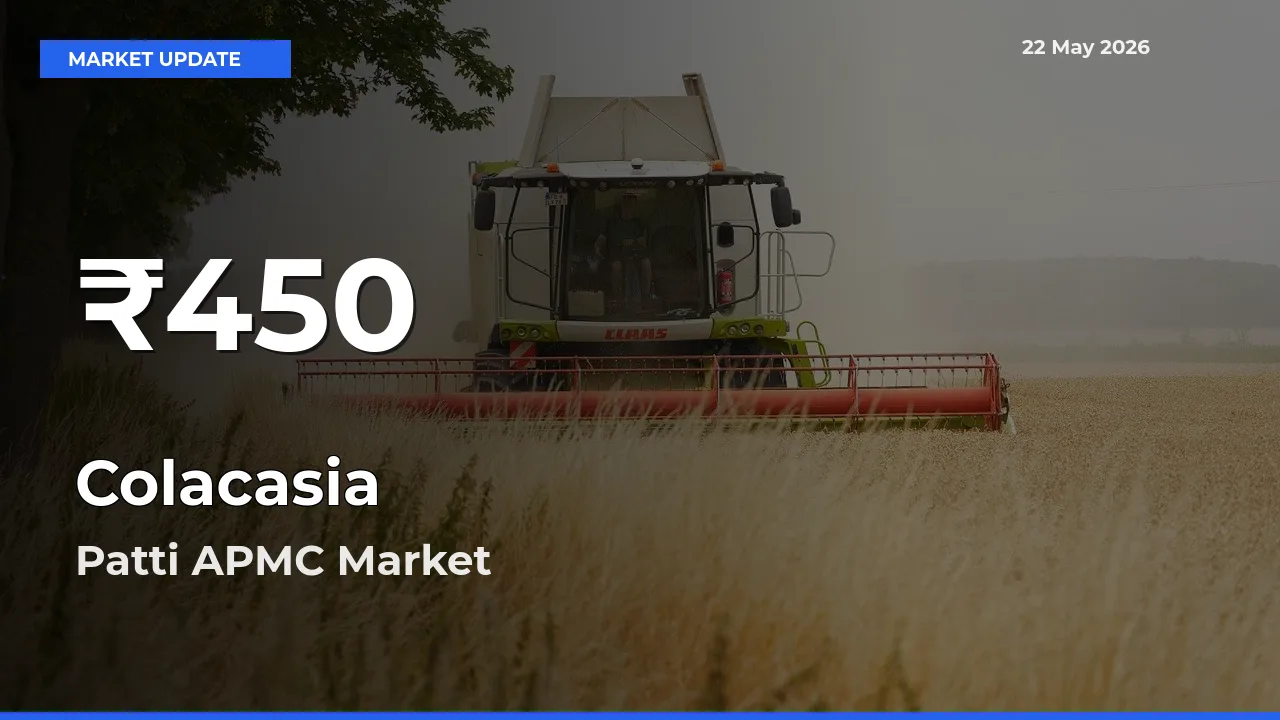
On 22 May 2026, Colacasia prices at Patti APMC slipped to a daily lowest level of ₹450 per quintal. The decline reflects immediate supply-side pressure and cautious buying activity in the physical market.
The lowest traded rate is a critical market indicator, as it reveals the price level at which sellers were compelled to transact. Such downward movement often signals temporary oversupply, softer demand, or short-term sentiment shifts among traders.
Compared to the previous session, the average mandi rate recorded a movement of 1.12%, highlighting the broader price direction beyond just the intraday low.
Today’s Colacasia Lowest Price – Detailed Snapshot
- Commodity: Colacasia
- Market: Patti APMC
- Date: 22 May 2026
- Lowest Price Today: ₹450 per quintal
- Highest Price Today: ₹8,000 per quintal
- Average Price: ₹4,641 per quintal
- Total Arrival: 0 quintals
Comparison with 30-Day Price Range
Over the past 30 days, Colacasia recorded a maximum of ₹8,500 and a minimum of ₹500, with the average settling at ₹4,591.
Today’s lowest price of ₹450 should be evaluated against this monthly band. If it approaches the 30-day minimum, the market may be testing a support level. A break below the monthly floor could indicate extended weakness.
Top Mandis – Price Comparison
| Mandi / Market | Price (₹ per quintal) |
|---|---|
| Pattukottai(Uzhavar Sandhai ) | ₹8,000 |
| Palakkad APMC | ₹7,700 |
| Attingal APMC | ₹7,000 |
| Cuddalore(Uzhavar Sandhai ) | ₹7,000 |
| Thalayolaparambu APMC | ₹7,000 |
| Sooramangalam(Uzhavar Sandhai ) | ₹6,700 |
| Anchal APMC | ₹6,700 |
| Paramakudi(Uzhavar Sandhai ) | ₹6,500 |
| Pattambi APMC | ₹6,500 |
| Thrippunithura APMC | ₹6,500 |
| Parassala APMC | ₹6,400 |
| Ramanathapuram(Uzhavar Sandhai ) | ₹6,250 |
Price differences across mandis highlight regional supply conditions. Markets with heavier arrivals may quote softer prices, while tighter supply centers can maintain relatively stronger bids.
20-Day Historical Trend Analysis
| Date | High (₹) | Low (₹) | Average (₹) |
|---|---|---|---|
| 2026-05-22 | ₹8,000 | ₹450 | ₹4,641 |
| 2026-05-21 | ₹8,000 | ₹500 | ₹4,589 |
| 2026-05-20 | ₹8,000 | ₹1,000 | ₹4,545 |
| 2026-05-19 | ₹8,000 | ₹750 | ₹4,511 |
| 2026-05-18 | ₹8,000 | ₹1,000 | ₹4,436 |
| 2026-05-17 | ₹8,000 | ₹3,000 | ₹5,109 |
| 2026-05-16 | ₹8,000 | ₹851 | ₹4,568 |
| 2026-05-15 | ₹8,000 | ₹800 | ₹4,428 |
| 2026-05-14 | ₹8,500 | ₹1,200 | ₹4,526 |
| 2026-05-13 | ₹8,000 | ₹1,000 | ₹4,672 |
| 2026-05-12 | ₹8,000 | ₹1,000 | ₹4,501 |
| 2026-05-11 | ₹8,000 | ₹800 | ₹4,631 |
| 2026-05-09 | ₹8,000 | ₹800 | ₹4,991 |
| 2026-05-07 | ₹8,000 | ₹1,400 | ₹4,652 |
| 2026-05-05 | ₹8,000 | ₹1,000 | ₹4,483 |
| 2026-05-04 | ₹8,000 | ₹1,300 | ₹4,516 |
The 20-day trend provides context for the current decline. A consistent downward pattern in daily lows may indicate sustained bearish momentum. However, if previous lows have repeatedly held at similar levels, the market could be nearing a short-term support zone.
What Does This Mean for Farmers?
Lower mandi prices can compress farmer margins, particularly when production and transportation costs remain elevated. Monitoring whether the current low is temporary or part of a broader downtrend is essential before making bulk selling decisions.
Strategic staggered selling, warehouse storage (if feasible), and comparing rates across nearby mandis can help improve price realization during weak phases.
Trader Perspective – Reading the Signals
For traders and wholesalers, a falling lowest price may indicate either short-term oversupply or cautious downstream demand. Procurement strategies often adjust quickly in such conditions to manage inventory risk and price volatility.
Short-Term Market Outlook
If arrivals remain elevated and demand stays moderate, prices could continue to face pressure in the near term. However, any reduction in supply flow or revival in bulk buying activity may help stabilize the market.
Continuous monitoring of daily mandi updates, 30-day comparisons, and historical price behavior remains critical for informed agricultural marketing decisions.