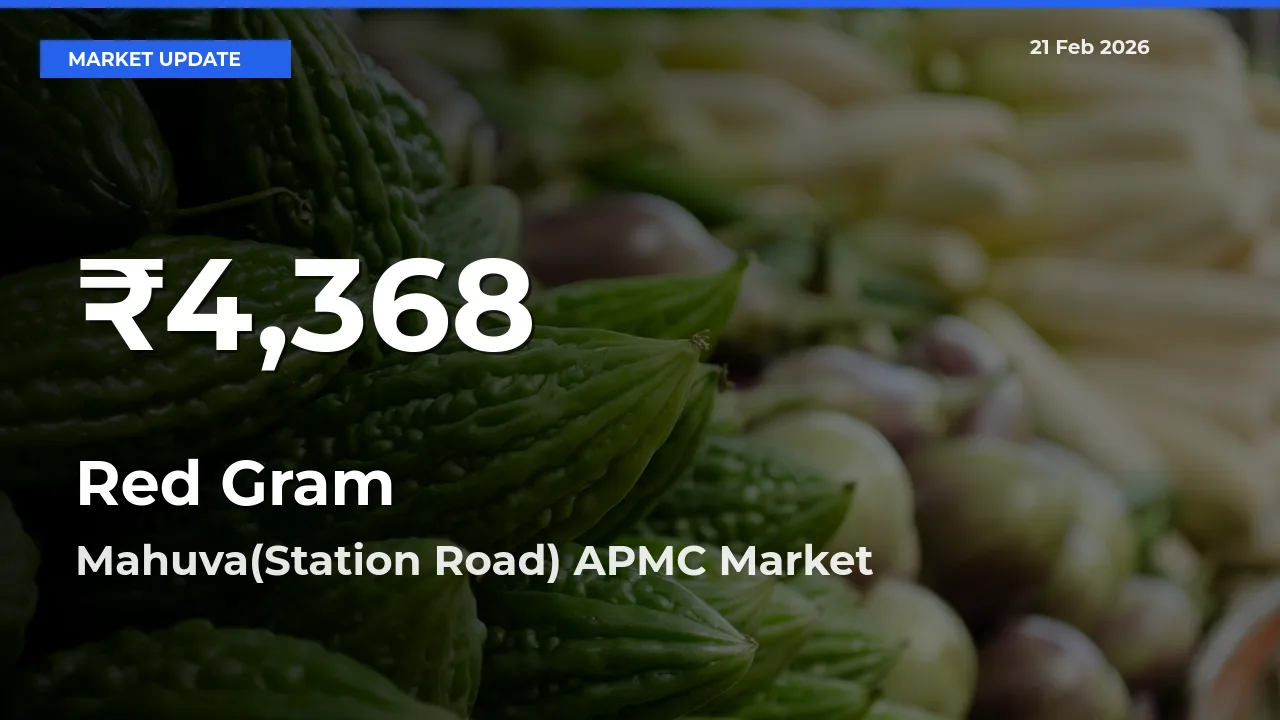
On 21 Feb 2026, the Red Gram market at Mahuva(Station Road) APMC witnessed a noticeable downturn, with prices touching a daily low of ₹3,500 per quintal. This lower band transaction reflects intensified selling pressure during the session and signals cautious buying behavior in the mandi.
The lowest traded price is often viewed as a stress indicator in commodity markets. It represents the level at which supply outweighed immediate demand, forcing sellers to accept comparatively weaker bids.
On a percentage basis, the average price shifted by -15.02% compared to the previous trading day. This movement provides a broader view of overall price direction beyond just the intraday low.
Daily Low Price Summary – Red Gram
- Lowest Price Today: ₹3,500 per quintal
- Highest Price Today: ₹7,286 per quintal
- Average (Modal) Price: ₹5,479 per quintal
- Total Arrivals: 0 quintals
- Active Mandis Reporting: 3
Position Within the 30-Day Trading Band
Over the previous 30 days, the commodity recorded a maximum of ₹8,072 and a minimum of ₹4,000, with an overall average of ₹6,377.
When compared against this range, today’s low of ₹3,500 indicates whether the market is approaching a key support level. If prices are nearing the 30-day bottom, the market could either stabilize or extend its decline depending on arrival flow and demand recovery.
Top Mandis – Cross-Market Price Comparison
| Market Name | Price (₹ per quintal) |
|---|---|
| Adoni APMC | ₹7,013 |
| Morbi APMC | ₹5,055 |
| Mahuva(Station Road) APMC | ₹4,368 |
Variations in prices across different mandis highlight regional imbalances. Markets experiencing higher arrivals generally report softer lower bands, while tighter supply centers tend to maintain relatively stable floors.
Supply Dynamics – Impact of Arrival Volume
The mandi registered total arrivals of 0 quintals. Elevated arrivals typically create short-term oversupply conditions, which can exert downward pressure on the lowest traded prices.
Conversely, if arrivals begin to moderate in upcoming sessions, the current low could act as a temporary support base.
20-Day Historical Trend – Evaluating Weakness or Stability
| Date | High (₹) | Low (₹) | Average (₹) |
|---|---|---|---|
| 2026-02-21 | ₹7,286 | ₹3,500 | ₹5,479 |
| 2026-02-20 | ₹7,309 | ₹4,655 | ₹6,447 |
| 2026-02-19 | ₹7,400 | ₹4,640 | ₹6,345 |
| 2026-02-18 | ₹7,500 | ₹4,580 | ₹6,134 |
| 2026-02-17 | ₹5,200 | ₹5,000 | ₹5,120 |
| 2026-02-16 | ₹7,481 | ₹4,625 | ₹6,328 |
| 2026-02-14 | ₹7,579 | ₹4,780 | ₹6,214 |
| 2026-02-13 | ₹7,619 | ₹4,511 | ₹6,596 |
| 2026-02-12 | ₹7,803 | ₹4,000 | ₹5,977 |
| 2026-02-11 | ₹5,225 | ₹4,505 | ₹4,872 |
| 2026-02-10 | ₹7,891 | ₹5,055 | ₹6,616 |
| 2026-02-09 | ₹7,922 | ₹7,272 | ₹7,922 |
| 2026-02-07 | ₹8,072 | ₹5,200 | ₹6,715 |
| 2026-02-06 | ₹8,052 | ₹4,000 | ₹6,929 |
| 2026-02-04 | ₹7,879 | ₹7,629 | ₹7,629 |
| 2026-02-03 | ₹7,859 | ₹4,705 | ₹6,628 |
Reviewing the 20-day trend helps determine whether the current decline is part of a sustained downward trajectory or merely a short-term correction. Repeated formation of lower lows would confirm bearish continuation, while stabilization near similar levels may signal consolidation.
Implications for Farmers
For producers, the fall to ₹3,500 necessitates cautious decision-making. Selling immediately at weaker levels may not always be optimal unless liquidity requirements are urgent.
Monitoring upcoming arrival patterns and comparing rates across neighboring mandis can support better price realization strategies.
Trader and Market Participant View
Traders interpret falling daily lows as a sign of short-term supply dominance. Inventory management becomes critical in such phases, as further decline can impact procurement margins and resale pricing.
Near-Term Outlook
If arrival volumes remain elevated and demand recovery is limited, prices may continue to trade under pressure. However, a reduction in supply inflow or renewed institutional buying could help establish a price floor.
Consistent monitoring of daily mandi updates, 30-day positioning, and historical trends remains essential for data-driven agricultural marketing decisions.