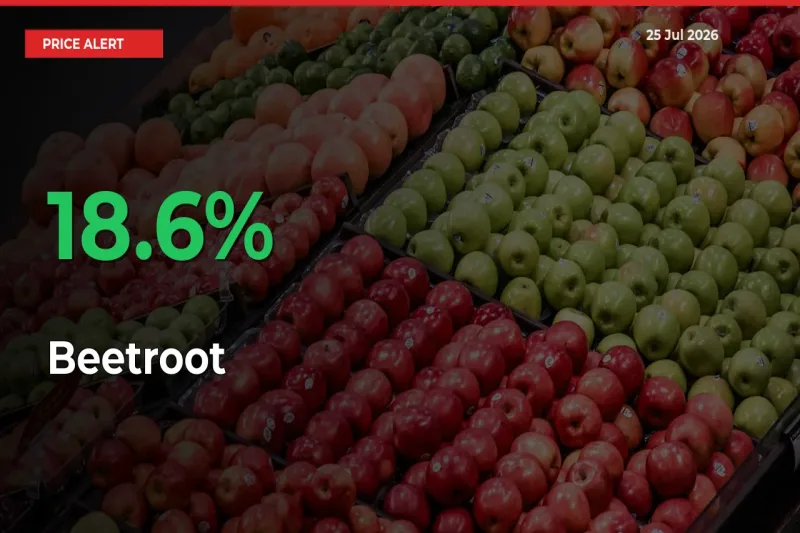
In a strong upward move on 25 Jul 2026, Beetroot prices at Local Market surged by 18.6% within a single trading session. This sudden spike exceeds normal daily fluctuations and signals aggressive buying activity in the mandi.
The average trading price climbed to ₹5,611, while the session recorded a high of ₹11,000 and a low of ₹2,400. A sharp upward shift in the average price typically reflects strong procurement demand and tightening supply conditions.
Sudden Price Spike – Key Market Indicators
- Mandi: Local Market
- One-Day Increase: 18.6%
- Average Price: ₹5,611
- Highest Price: ₹11,000
- Lowest Price: ₹2,400
- Active Mandis Reporting: 118
If the session high significantly exceeds the average, it indicates that certain transactions were executed under aggressive bidding, reinforcing bullish sentiment in the agricultural market.
Comparison with the 30-Day Price Range
Over the last 30 days, the commodity reached a maximum of ₹12,000 and a minimum of ₹44, maintaining an average of ₹4,627.
If the current average price is moving toward the upper boundary of this monthly range, it suggests strengthening momentum. However, if prices were already near the upper band, the spike could represent short-term buying enthusiasm rather than structural change.
Major Mandis – Price Alignment
| Mandi | Price (₹ per quintal) |
|---|---|
| Karur(Uzhavar Sandhai ) | ₹9,750 |
| Gandhigramam(Uzhavar Sandhai) | ₹9,750 |
| Tiruchengode APMC | ₹9,500 |
| Tiruppur (South) (Uzhavar Sandhai ) | ₹9,500 |
| Namakkal(Uzhavar Sandhai ) | ₹9,500 |
| Paramathivelur(Uzhavar Sandhai ) | ₹9,500 |
| Sundarapuram(Uzhavar Sandhai ) | ₹9,250 |
| RSPuram(Uzhavar Sandhai ) | ₹9,000 |
| Gobichettipalayam(Uzhavar Sandhai ) | ₹8,750 |
| Edapadi (Uzhavar Sandhai ) | ₹8,750 |
| Vadavalli (Uzhavar Sandhai) | ₹8,500 |
| Dharapuram(Uzhavar Sandhai ) | ₹8,500 |
If similar upward movement is observed across key mandis, the spike can be considered network-wide rather than isolated to a single market.
20-Day Historical Trend Analysis
| Date | High (₹) | Low (₹) | Average (₹) |
|---|---|---|---|
| 25 Jul | ₹11,000 | ₹2,400 | ₹5,611 |
| 24 Jul | ₹10,400 | ₹500 | ₹4,731 |
| 23 Jul | ₹10,000 | ₹500 | ₹4,854 |
| 22 Jul | ₹9,200 | ₹500 | ₹4,776 |
| 21 Jul | ₹10,000 | ₹600 | ₹4,797 |
| 20 Jul | ₹10,000 | ₹500 | ₹4,797 |
| 19 Jul | ₹10,000 | ₹400 | ₹5,199 |
| 18 Jul | ₹9,500 | ₹400 | ₹4,768 |
| 17 Jul | ₹10,000 | ₹400 | ₹4,815 |
| 16 Jul | ₹9,500 | ₹500 | ₹4,757 |
| 15 Jul | ₹10,000 | ₹44 | ₹4,759 |
| 14 Jul | ₹10,500 | ₹500 | ₹4,783 |
| 13 Jul | ₹10,000 | ₹500 | ₹4,773 |
| 12 Jul | ₹9,600 | ₹400 | ₹5,019 |
| 11 Jul | ₹10,000 | ₹700 | ₹4,806 |
| 10 Jul | ₹9,000 | ₹500 | ₹4,578 |
| 09 Jul | ₹9,400 | ₹500 | ₹4,579 |
| 08 Jul | ₹12,000 | ₹500 | ₹4,682 |
| 07 Jul | ₹9,500 | ₹500 | ₹4,528 |
| 06 Jul | ₹9,000 | ₹500 | ₹4,344 |
| 05 Jul | ₹9,000 | ₹1,000 | ₹4,821 |
If prices have been gradually strengthening over the past sessions, today’s surge may represent continuation of an existing uptrend. If earlier trading was stable, the spike may be driven by sudden bulk buying or supply disruption.
Implications for Farmers
A sudden price spike can create favorable selling opportunities. However, farmers should evaluate whether the momentum is sustainable before making large-volume sales decisions.
Trader Perspective
For traders, rapid price increases can increase procurement costs and inventory risk. Balanced buying strategies and close monitoring of arrival trends are essential during volatile sessions.
Final Market Assessment
The recorded 18.6% surge highlights short-term strength in the Beetroot market. Long-term direction will depend on sustained demand, arrival patterns, and multi-mandi confirmation in the coming sessions.