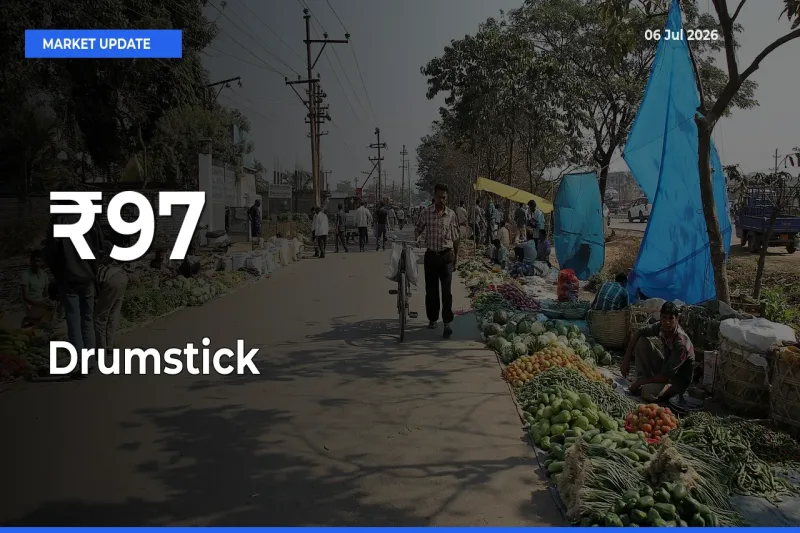
The mandi trend for Drumstick on 06 Jul 2026 reflects a synchronized price movement across 97 reporting mandis. When multiple agricultural markets display alignment in pricing direction, it generally indicates a macro-level demand–supply adjustment rather than isolated volatility.
The consolidated average price registered a 2.28% change compared to the previous trading day. Such a shift across multiple mandis strengthens the credibility of the ongoing market trend.
Consolidated Price Structure Across Mandis
The day’s aggregated trading range shows:
- Highest Price: ₹10,000 per quintal
- Lowest Price: ₹1,000 per quintal
- Average Market Price: ₹5,595 per quintal
- Total Reporting Mandis: 97
A narrow spread between high and low prices across mandis typically suggests stability, while a widening spread may indicate transitional phases or uneven arrival distribution.
Where Does the Current Trend Stand Within the 30-Day Framework?
Over the last 30 trading sessions, the commodity touched a high of ₹20,000 and a low of ₹335, maintaining an average of ₹6,234.
If today’s average price sustains above the 30-day mean, it may signal structural strengthening. Conversely, trading closer to the lower band could imply weakening demand or supply-led correction.
Top Mandis – Regional Price Benchmarking
| Market Name | Price (₹ per quintal) |
|---|---|
| Dharmapuri(Uzhavar Sandhai ) | ₹8,750 |
| Pennagaram(Uzhavar Sandhai ) | ₹8,750 |
| Attayampatti(Uzhavar Sandhai ) | ₹8,500 |
| Krishnagiri(Uzhavar Sandhai ) | ₹8,500 |
| Chavakkad Market | ₹8,000 |
| Rattihalli (Uzhavar Sandhai) | ₹8,000 |
| Thrippunithura Market | ₹7,500 |
| Athirampuzha Market | ₹7,100 |
| Kottarakkara Market | ₹7,000 |
| Pampady Market | ₹7,000 |
| Sankarapuram(Uzhavar Sandhai ) | ₹7,000 |
| Hoskote APMC | ₹7,000 |
The leading mandis serve as benchmark indicators for regional pricing. When top markets mirror each other’s direction, it reinforces confidence in the overall mandi trend.
20-Day Historical Movement – Pattern Evaluation
| Date | High (₹) | Low (₹) | Average (₹) |
|---|---|---|---|
| 06 Jul | ₹10,000 | ₹1,000 | ₹5,595 |
| 05 Jul | ₹10,000 | ₹1,000 | ₹5,471 |
| 04 Jul | ₹15,000 | ₹1,000 | ₹5,412 |
| 03 Jul | ₹15,000 | ₹1,000 | ₹5,388 |
| 02 Jul | ₹12,000 | ₹1,000 | ₹5,328 |
| 01 Jul | ₹12,000 | ₹1,000 | ₹5,444 |
| 30 Jun | ₹20,000 | ₹1,000 | ₹5,673 |
| 29 Jun | ₹20,000 | ₹1,000 | ₹5,890 |
| 28 Jun | ₹12,000 | ₹2,000 | ₹6,332 |
| 27 Jun | ₹15,000 | ₹1,000 | ₹6,447 |
| 26 Jun | ₹12,000 | ₹2,000 | ₹6,605 |
| 25 Jun | ₹20,000 | ₹1,500 | ₹6,702 |
| 24 Jun | ₹20,000 | ₹1,400 | ₹6,917 |
| 23 Jun | ₹18,000 | ₹335 | ₹6,971 |
| 22 Jun | ₹20,000 | ₹1,000 | ₹7,371 |
| 21 Jun | ₹13,000 | ₹2,000 | ₹8,039 |
| 20 Jun | ₹20,000 | ₹1,000 | ₹8,227 |
| 19 Jun | ₹20,000 | ₹700 | ₹8,585 |
| 18 Jun | ₹20,000 | ₹1,000 | ₹8,284 |
| 17 Jun | ₹15,000 | ₹1,000 | ₹8,054 |
| 16 Jun | ₹20,000 | ₹900 | ₹8,080 |
Analysis of the past 20 days helps determine whether the present multi-mandi movement is accelerating or stabilizing. Consistent directional shifts across days validate trend sustainability, while erratic fluctuations may signal consolidation.
Strategic Implications for Farmers
A unified mandi trend allows farmers to assess whether price changes are region-specific or systemic. When most mandis align, pricing decisions can be made with greater confidence in overall market direction.
Trader and Wholesaler Perspective
For traders, synchronized mandi movement reduces arbitrage gaps and provides clearer procurement signals. Multi-market confirmation strengthens inventory planning and risk management strategies.
Forward-Looking Market View
The coordinated price action across 97 mandis suggests that the current direction—whether upward or downward— has structural backing. Continued monitoring of arrival flow, regional spreads, and historical alignment will remain critical for anticipating the next phase of price movement.
Consistent multi-mandi trend analysis enhances transparency and supports data-driven agricultural decision-making for all stakeholders.