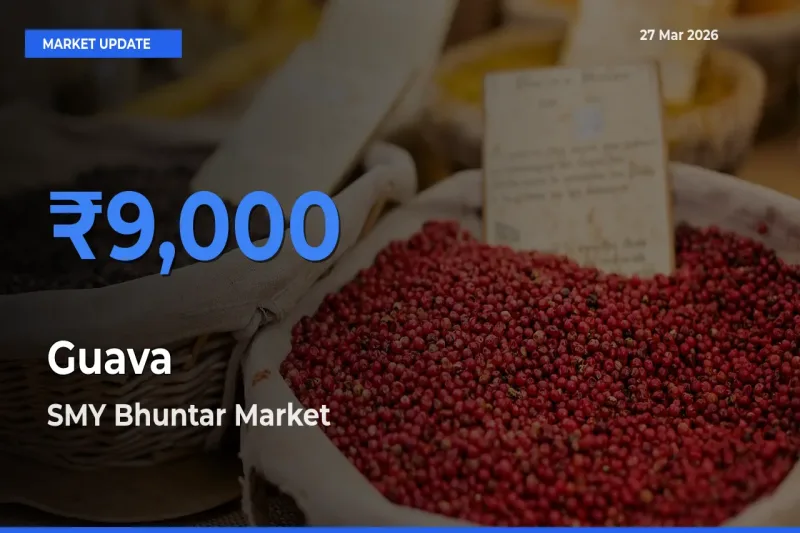
On 27 Mar 2026, SMY Bhuntar emerged as the top-performing mandi for Guava, recording the highest traded price of ₹9,000 per quintal. Among all reporting markets, this mandi outperformed peers, setting the benchmark for the day.
When a single mandi leads the price chart across the network, it signals strong competitive bidding, quality arrivals, and robust buyer participation rather than isolated transactions.
SMY Bhuntar – Competitive Market Leadership
- Commodity: Guava
- Date: 27 Mar 2026
- Highest Recorded Price: ₹9,000
- Average Trading Price: ₹5,656
- Total Active Mandis: 90
A strong average alongside the highest price indicates that the leadership is supported by broader trading strength, not just one or two premium deals. Such performance often reflects higher-quality produce, better logistics, or stronger procurement demand in this mandi.
Comparison with Other Major Mandis
| Mandi | Price (₹ per quintal) |
|---|---|
| SMY Bhuntar | ₹9,000 |
| SMY Dharamshala | ₹8,500 |
| Karaikudi(Uzhavar Sandhai ) APMC | ₹8,000 |
| Kumbakonam (Uzhavar Sandhai ) APMC | ₹8,000 |
| PMY Kangni Mandi | ₹8,000 |
| Narwal Jammu (F&V) APMC | ₹8,000 |
| Singampunari(Uzhavar Sandhai ) APMC | ₹7,750 |
| Sivagangai (Uzhavar Sandhai ) APMC | ₹7,700 |
| Devakottai (Uzhavar Sandhai ) APMC | ₹7,500 |
| Anna nagar(Uzhavar Sandhai ) APMC | ₹7,500 |
| SMY Jaisinghpur | ₹7,500 |
| Chokkikulam(Uzhavar Sandhai ) APMC | ₹7,500 |
The comparison above clearly shows that SMY Bhuntar maintained a price edge over other markets. In such cases, the leading mandi often becomes a reference point for regional price discovery.
Arrival Volume and Quality Impact
Total arrivals were reported at 0 quintals. Higher-quality arrivals or concentrated buying interest can push prices above competing mandis, reinforcing the top position.
30-Day Performance Context
Over the last 30 days, the commodity recorded a high of ₹12,000 and a low of ₹300.
If today’s top price approaches or exceeds the monthly high, it signals strong competitive positioning. Sustained performance near the upper range indicates structural strength rather than temporary fluctuation.
20-Day Historical Trend Review
| Date | High (₹) | Low (₹) | Average (₹) |
|---|---|---|---|
| 27 Mar | ₹11,000 | ₹2,500 | ₹5,656 |
| 26 Mar | ₹10,000 | ₹1,000 | ₹5,383 |
| 25 Mar | ₹11,000 | ₹300 | ₹5,478 |
| 24 Mar | ₹10,000 | ₹500 | ₹5,336 |
| 23 Mar | ₹10,000 | ₹300 | ₹5,469 |
| 22 Mar | ₹12,000 | ₹900 | ₹5,567 |
| 21 Mar | ₹12,000 | ₹700 | ₹5,459 |
| 20 Mar | ₹12,000 | ₹500 | ₹5,342 |
| 19 Mar | ₹12,000 | ₹2,600 | ₹5,663 |
| 18 Mar | ₹12,000 | ₹3,000 | ₹5,655 |
| 17 Mar | ₹12,000 | ₹2,500 | ₹5,486 |
| 16 Mar | ₹12,000 | ₹2,200 | ₹5,571 |
| 15 Mar | ₹12,000 | ₹1,500 | ₹5,616 |
| 13 Mar | ₹11,000 | ₹700 | ₹5,804 |
| 12 Mar | ₹8,000 | ₹1,600 | ₹4,919 |
| 11 Mar | ₹12,000 | ₹700 | ₹5,872 |
If this mandi has consistently recorded higher levels over recent sessions, it may indicate sustained competitive advantage. However, if today’s jump is sudden, it could be driven by short-term demand spikes or selective premium arrivals.
Strategic Importance for Farmers
Identifying the top mandi is critical for farmers seeking better price realization. While higher rates are attractive, transportation costs, timing, and produce grading must also be considered before shifting supply.
Trader & Market Perspective
Traders frequently use the leading mandi as a pricing benchmark. If this market consistently leads, it can influence regional price expectations and procurement strategies.
Conclusion
On 27 Mar 2026, SMY Bhuntar secured the highest position for Guava pricing. Continued monitoring of historical trends, arrival patterns, and cross-mandi comparisons will determine whether this leadership is sustainable in the coming sessions.