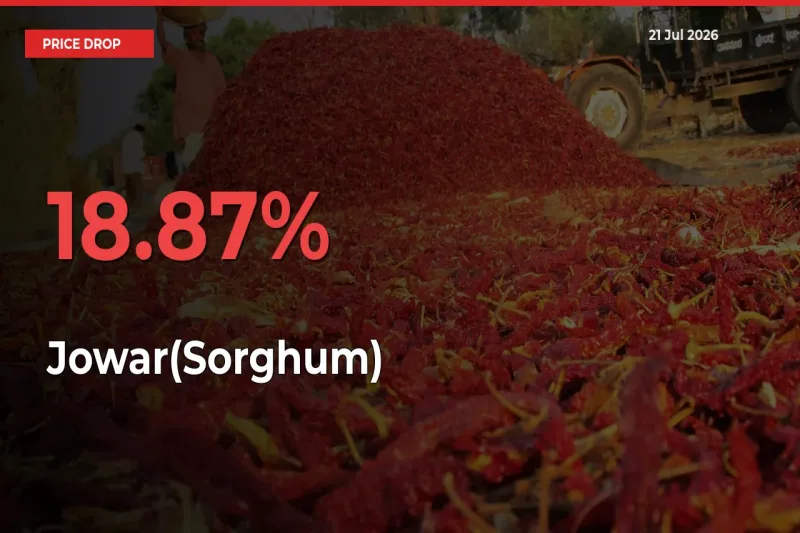
On 21 Jul 2026, Jowar(Sorghum) prices at Local Market recorded a sharp 18.87% decline within a single trading session. Such a sudden drop signals immediate market pressure and reflects a swift shift in short-term supply-demand dynamics.
The average trading price settled at ₹3,055, with the session high at ₹3,250 and the low at ₹2,860. The sharp percentage correction suggests that selling intensity outweighed buying momentum during the day.
Understanding the Sudden Price Drop
A one-day fall of 18.87% is typically beyond routine market fluctuation. It may indicate:
- Unexpected surge in arrivals leading to temporary oversupply
- Weak procurement activity from traders or bulk buyers
- Short-term sentiment shift due to external or regional factors
- Profit booking or panic selling after previous gains
- Daily Percentage Drop: 18.87%
- Average Price: ₹3,055
- Highest Level: ₹3,250
- Lowest Level: ₹2,860
- Active Mandis: 2
Position Within the 30-Day Price Framework
In the last 30 days, the commodity recorded a high of ₹7,855 and a low of ₹200, maintaining an average of ₹3,646.
If the current average begins approaching the lower boundary of this range, it may signal short-term weakness. A breach below the 30-day minimum could suggest structural downside pressure rather than temporary volatility.
Impact of Arrival Volume
Total arrivals were reported at 0 quintals. A sudden increase in supply without proportional demand expansion often accelerates price declines, especially in spot markets.
Price Movement Across Major Mandis
| Mandi | Price (₹ per quintal) |
|---|---|
| Manvi APMC | ₹3,250 |
| Indore APMC | ₹2,860 |
If similar downward adjustments are observed across multiple mandis, the pressure can be considered broad-based rather than isolated to a single region.
20-Day Historical Trend Assessment
| Date | High (₹) | Low (₹) | Average (₹) |
|---|---|---|---|
| 21 Jul | ₹3,250 | ₹2,860 | ₹3,055 |
| 20 Jul | ₹7,120 | ₹1,231 | ₹3,766 |
| 19 Jul | ₹4,500 | ₹2,000 | ₹3,022 |
| 18 Jul | ₹7,265 | ₹200 | ₹3,812 |
| 17 Jul | ₹7,015 | ₹1,440 | ₹3,643 |
| 16 Jul | ₹6,600 | ₹1,505 | ₹3,446 |
| 15 Jul | ₹7,200 | ₹1,515 | ₹3,828 |
| 14 Jul | ₹7,250 | ₹1,650 | ₹3,857 |
| 13 Jul | ₹7,285 | ₹1,345 | ₹3,765 |
| 12 Jul | ₹6,100 | ₹1,750 | ₹3,745 |
| 11 Jul | ₹7,295 | ₹1,200 | ₹3,861 |
| 10 Jul | ₹7,850 | ₹1,305 | ₹3,662 |
| 09 Jul | ₹7,545 | ₹1,600 | ₹3,684 |
| 08 Jul | ₹7,465 | ₹1,501 | ₹3,785 |
| 07 Jul | ₹7,555 | ₹1,600 | ₹3,725 |
| 06 Jul | ₹7,855 | ₹1,450 | ₹3,509 |
| 05 Jul | ₹4,852 | ₹2,000 | ₹3,269 |
| 04 Jul | ₹7,440 | ₹1,238 | ₹3,943 |
| 03 Jul | ₹7,170 | ₹1,226 | ₹3,539 |
| 02 Jul | ₹7,180 | ₹1,660 | ₹3,532 |
| 01 Jul | ₹7,250 | ₹1,500 | ₹3,484 |
Reviewing the 20-day trend helps determine whether today’s fall is a continuation of gradual weakness or an abrupt market shock. If prices have been steadily declining, the drop confirms momentum. If the trend was stable earlier, this may represent short-term volatility.
Implications for Farmers
A sharp drop can create uncertainty among producers. Some may prefer immediate liquidation to avoid further downside, while others may wait for stabilization depending on storage capacity and cash flow requirements.
Trader and Procurement Perspective
For traders, sudden declines can present short-term buying opportunities if underlying demand remains intact. However, risk management becomes critical in volatile sessions, especially when price discovery remains unstable.
Conclusion
The recorded 18.87% single-day drop highlights immediate downside pressure in the Jowar(Sorghum) market. Close monitoring of arrivals, multi-mandi alignment, and historical positioning will be essential to determine whether this decline is temporary or part of a broader corrective phase.