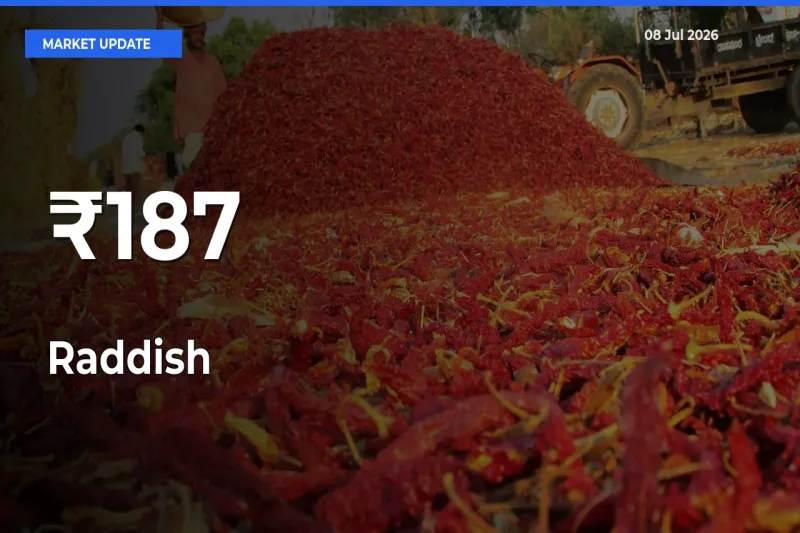
On 08 Jul 2026, Raddish prices displayed a clear multi-mandi trend across 187 active agricultural markets. When several mandis move in the same direction on the same day, it reflects a broader shift in supply-demand balance rather than isolated local price fluctuations.
The consolidated average price changed by 10.81% compared to the previous session. Such a coordinated percentage movement across mandis strengthens the reliability of the emerging market trend.
Multi-Mandi Price Overview – Key Numbers at a Glance
- Highest Price Across Mandis: ₹5,000 per quintal
- Lowest Price Across Mandis: ₹500 per quintal
- Average Trading Price: ₹3,146 per quintal
- Total Reporting Mandis: 187
The spread between the day’s high and low levels offers insight into volatility. A narrower band suggests stable trading conditions, while a wider band may indicate transitional phases or uneven demand absorption.
30-Day Context – Is the Trend Strengthening or Reversing?
Over the past 30 days, the commodity reached a peak of ₹9,000 and a floor of ₹10, with an average of ₹2,965.
If the current consolidated average remains above the 30-day midpoint, it signals resilience and potential strengthening momentum. If prices are trending toward the lower boundary, the market may be entering a corrective or supply-driven phase.
Top Mandis – Regional Price Alignment
| Mandi / Market | Price (₹ per quintal) |
|---|---|
| Paruthipattu(Uzhavar Sandhai ) | ₹5,000 |
| Sankarapuram(Uzhavar Sandhai ) | ₹5,000 |
| Kallakurichi(Uzhavar Sandhai ) | ₹5,000 |
| Vadaseri APMC | ₹4,750 |
| Chengalpet(Uzhavar Sandhai ) | ₹4,500 |
| Jameenrayapettai(Uzhavar Sandhai ) | ₹4,500 |
| Nanganallur(Uzhavar Sandhai ) | ₹4,500 |
| Guduvancheri(Uzhavar Sandhai ) | ₹4,500 |
| Pallavaram(Uzhavar Sandhai ) | ₹4,500 |
| Pattukottai(Uzhavar Sandhai ) | ₹4,400 |
| Ramanathapuram(Uzhavar Sandhai ) | ₹4,350 |
| Anna nagar(Uzhavar Sandhai ) | ₹4,300 |
The comparison above highlights regional consistency. When leading mandis show similar directional movement, it reinforces the credibility of the broader mandi trend.
Market Sentiment – Broad-Based Uptrend
A majority of mandis registered price increases, indicating strong demand absorption and positive procurement sentiment. Such widespread upward movement suggests structural strength in the commodity market.
20-Day Historical Pattern – Trend Confirmation
| Date | High (₹) | Low (₹) | Average (₹) |
|---|---|---|---|
| 08 Jul | ₹5,000 | ₹500 | ₹3,146 |
| 07 Jul | ₹5,000 | ₹10 | ₹2,839 |
| 06 Jul | ₹5,000 | ₹10 | ₹2,573 |
| 05 Jul | ₹5,000 | ₹10 | ₹3,099 |
| 04 Jul | ₹5,300 | ₹300 | ₹2,911 |
| 03 Jul | ₹6,000 | ₹300 | ₹2,874 |
| 02 Jul | ₹6,000 | ₹10 | ₹2,888 |
| 01 Jul | ₹6,000 | ₹10 | ₹2,955 |
| 30 Jun | ₹6,000 | ₹10 | ₹2,895 |
| 29 Jun | ₹6,000 | ₹10 | ₹3,004 |
| 28 Jun | ₹6,000 | ₹10 | ₹3,163 |
| 27 Jun | ₹6,000 | ₹10 | ₹3,048 |
| 26 Jun | ₹6,000 | ₹10 | ₹3,094 |
| 25 Jun | ₹6,000 | ₹10 | ₹2,974 |
| 24 Jun | ₹6,000 | ₹10 | ₹2,998 |
| 23 Jun | ₹6,000 | ₹10 | ₹2,934 |
| 22 Jun | ₹6,500 | ₹10 | ₹2,978 |
| 21 Jun | ₹9,000 | ₹10 | ₹3,267 |
| 20 Jun | ₹6,000 | ₹300 | ₹2,992 |
| 19 Jun | ₹6,000 | ₹10 | ₹2,960 |
| 18 Jun | ₹6,500 | ₹10 | ₹2,948 |
The 20-day data series helps validate whether the current multi-mandi movement is accelerating or stabilizing. Consistent directional shifts over consecutive days provide stronger confirmation of a sustained trend.
What This Means for Farmers
A synchronized mandi trend offers clarity. When most markets align, farmers can assess selling opportunities with greater confidence, knowing the movement reflects broader market fundamentals rather than isolated price swings.
Trader Strategy – Reading the Network Signals
For traders and wholesalers, uniform price movement across mandis reduces uncertainty and improves procurement planning. Cross-mandi alignment often signals a stable directional bias, enabling better risk management.
Outlook – Watching the Next Phase
The coordinated movement across 187 mandis suggests that the current trend has structural support. Monitoring arrival patterns, 30-day boundaries, and daily price spreads will remain essential for anticipating the next major move.
Regular tracking of multi-mandi trends empowers stakeholders with actionable agricultural market intelligence and improves long-term decision-making.